

Artwork by Bruno Rios
The Time Machine transformed the idea of travelling through time by making it a technological act rather than a dream, supernatural journey or unexplained leap. H. G. Wells’s extraordinary novel carries its unnamed Traveller to the year 802,701, where humanity has divided into the Eloi and Morlocks, turning Victorian class divisions and evolutionary theory into a disturbing vision of the distant future. Published in 1895 after seven years of rewriting, The Time Machine remains one of the defining works of science fiction, a story not simply about where humanity might be going, but what might become of us when we get there.
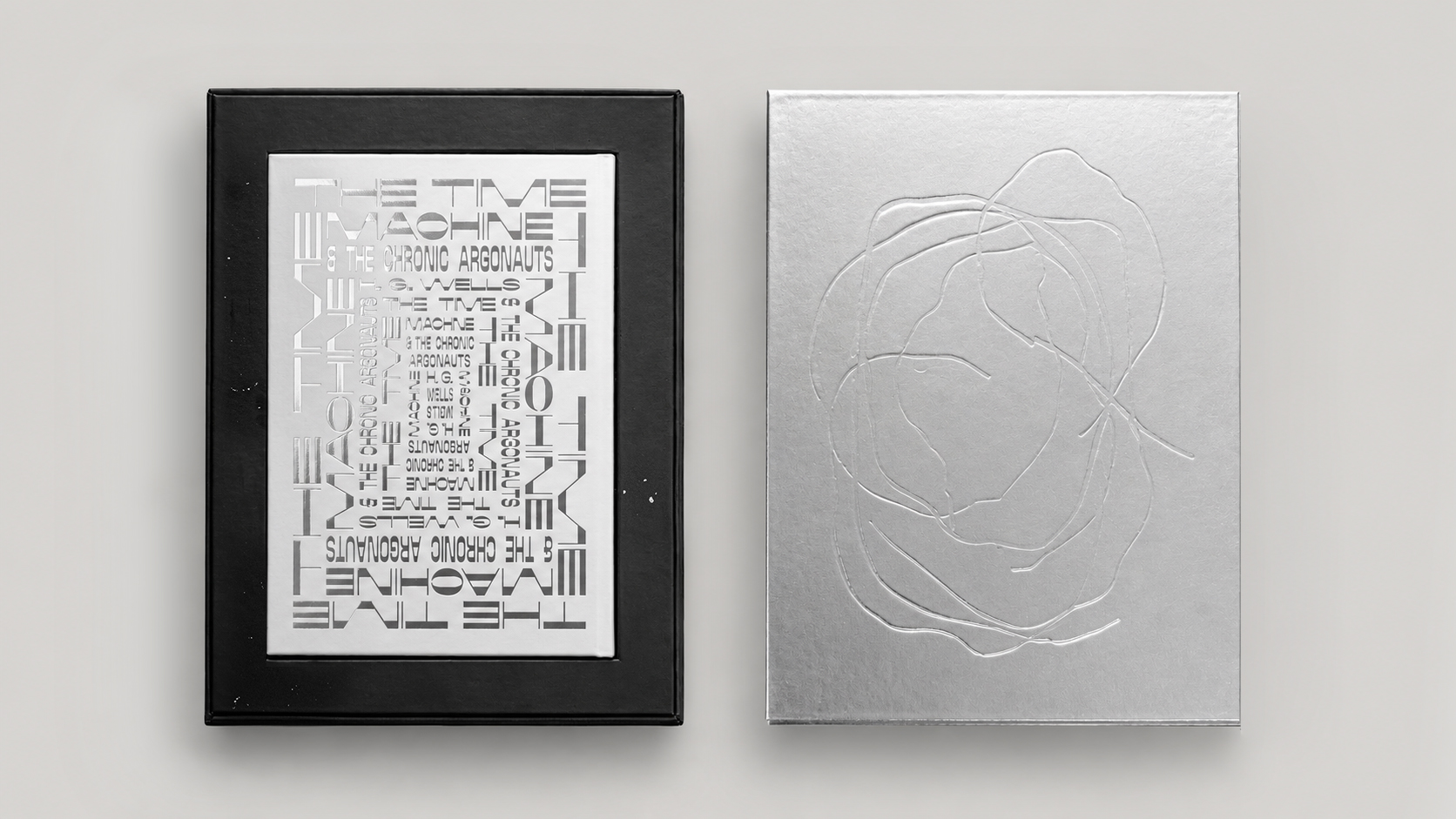
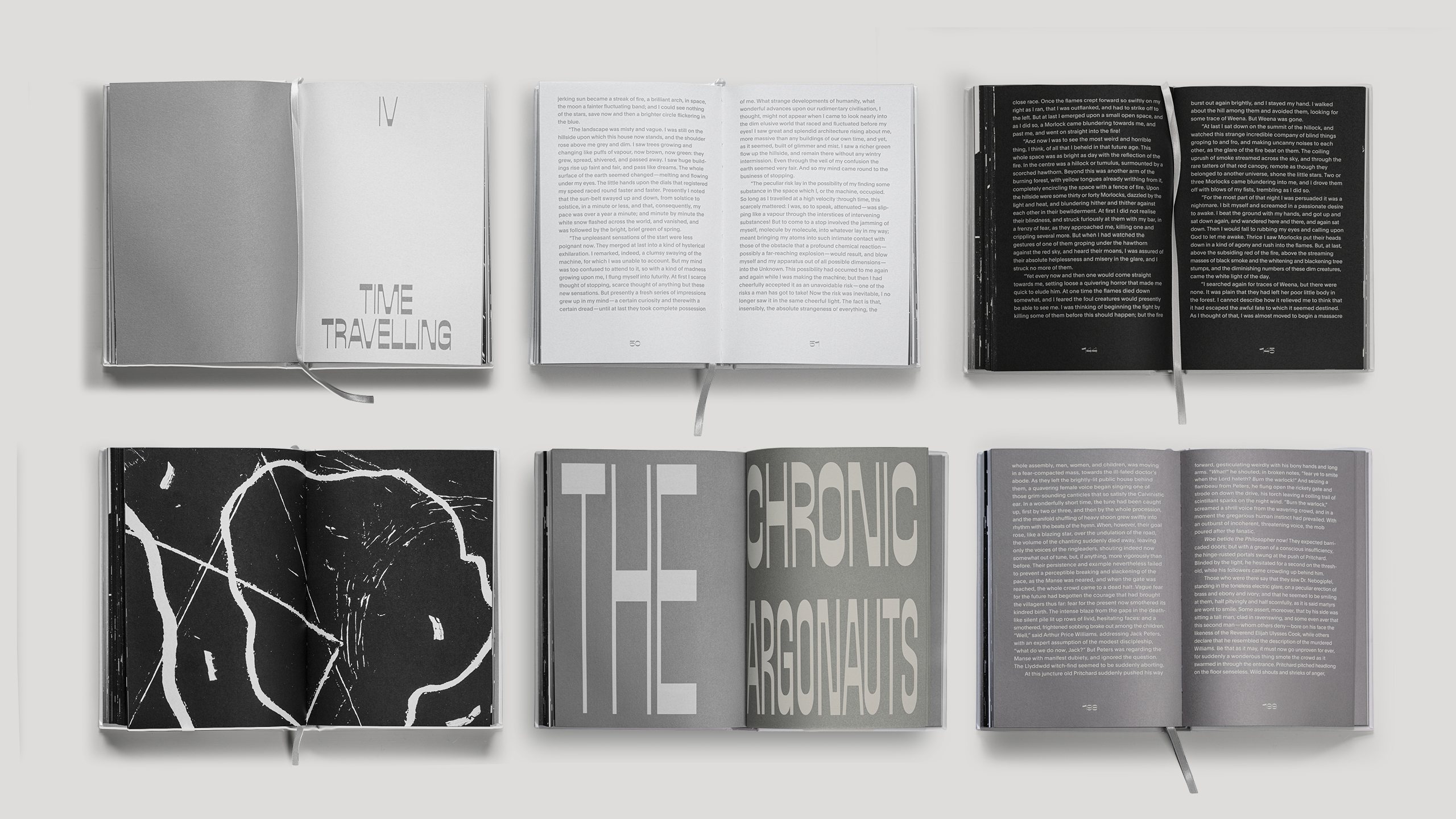
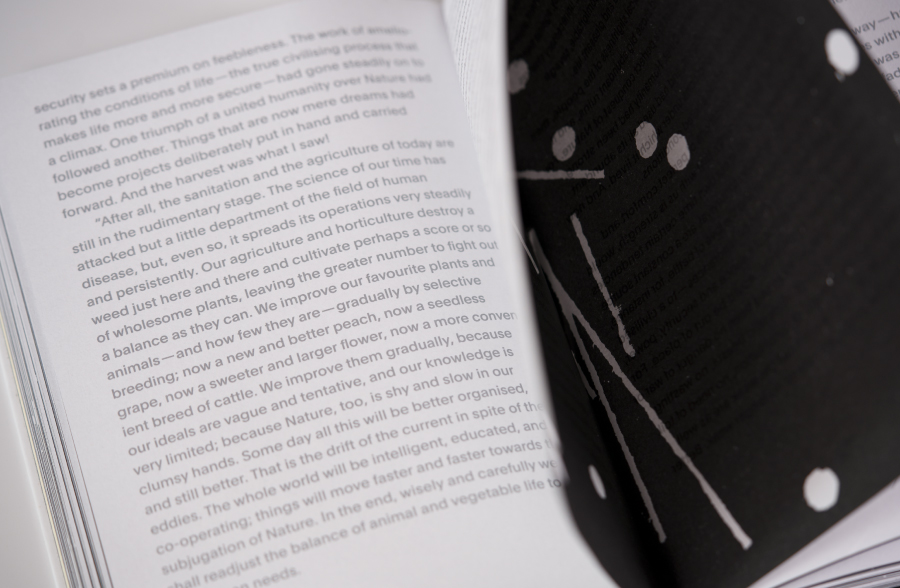
The edition is printed on three different papers, selected to create the gradual visual transition through the Traveller’s journey.
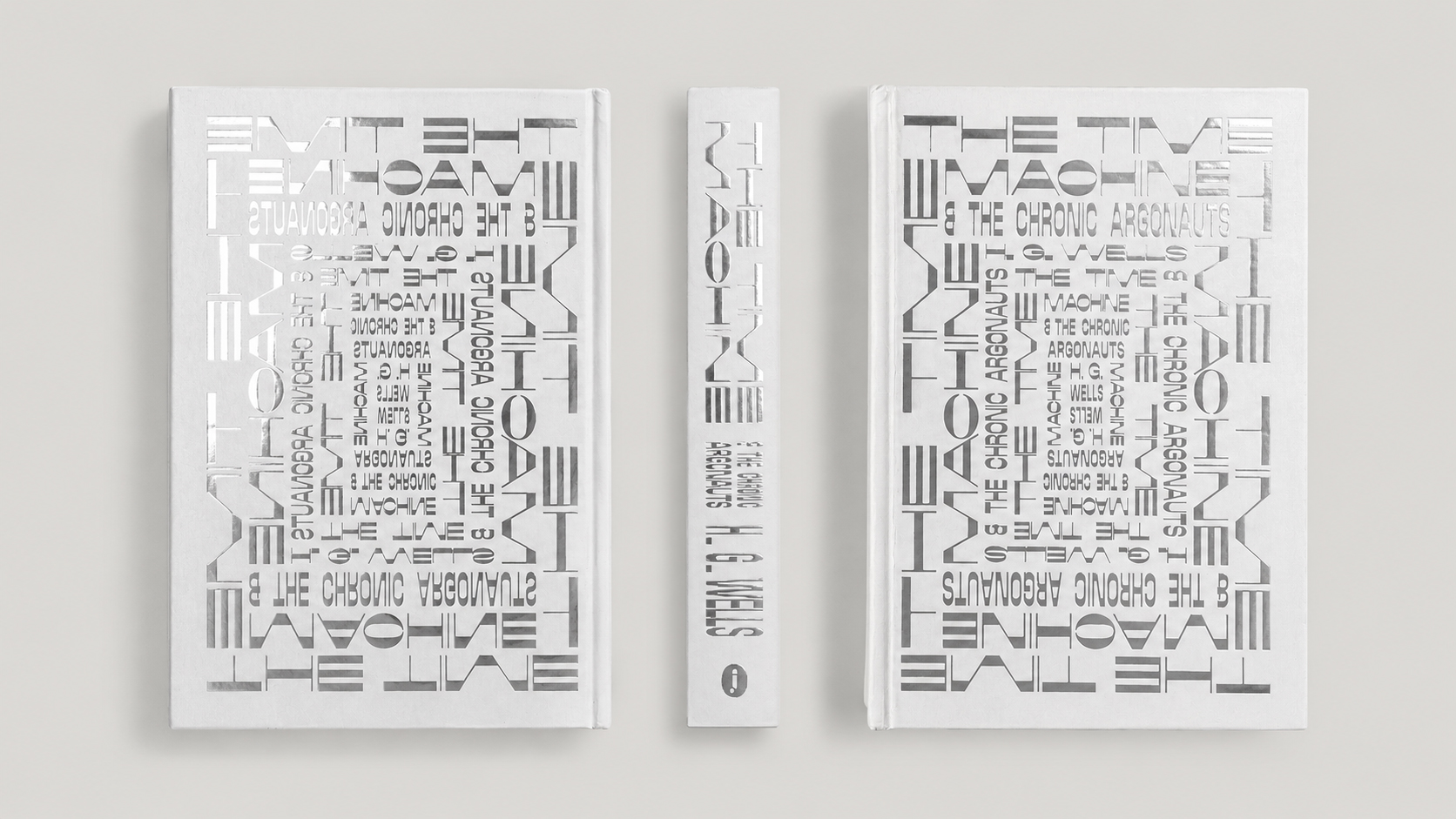
The text is printed in silver ink throughout, with typography specially developed for the edition and used as an integral part of its visual design.
The volume includes The Chronic Argonauts, Wells’s 1888 precursor to The Time Machine, presenting his earliest surviving version of the idea alongside the finished novel.
Original abstract illustrations run throughout the book, with the Morlock illustrations concealed inside specially folded pages.
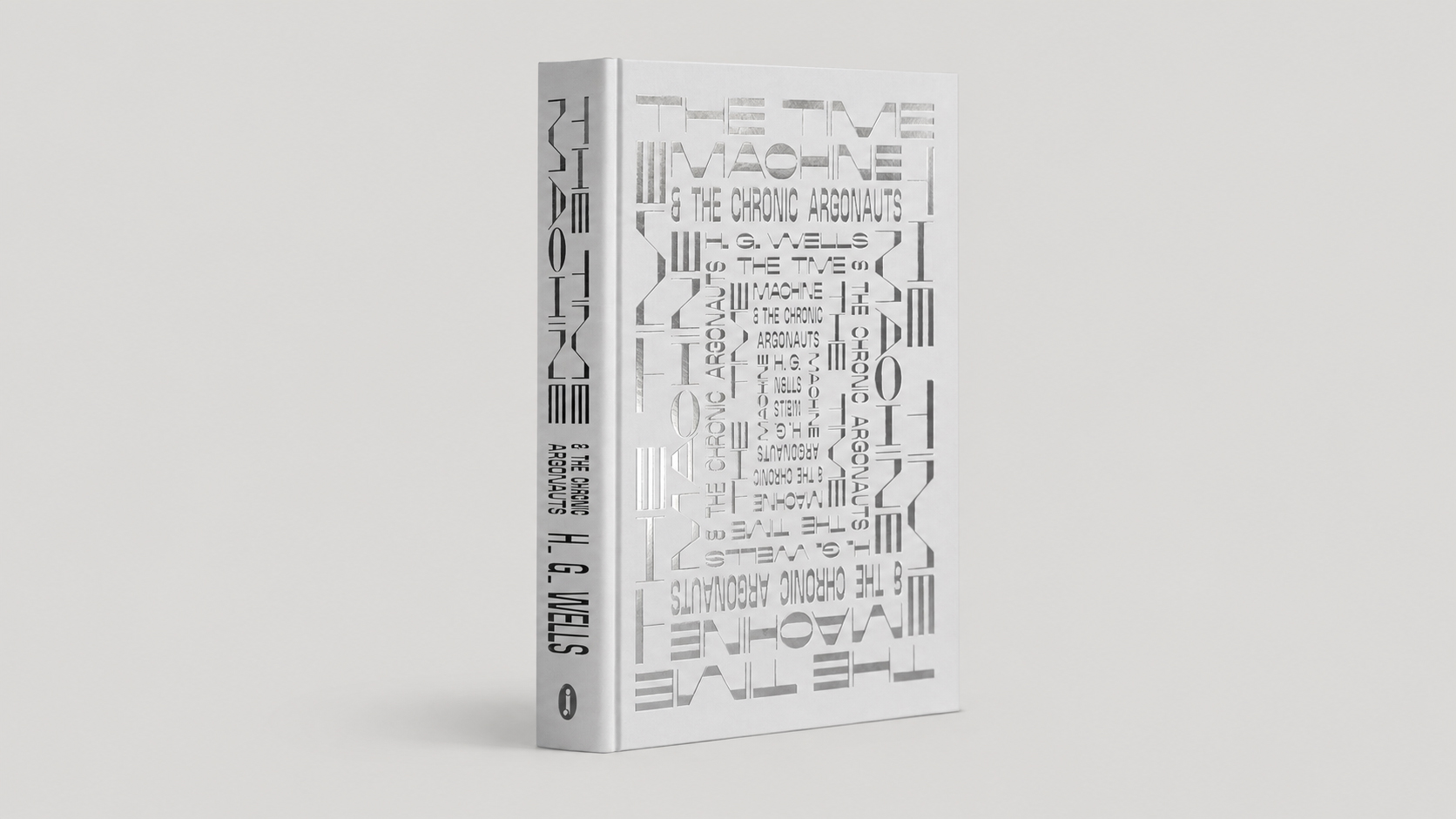
The binding, cover and typographic treatment have all been designed specifically for this edition, turning the physical construction of the book into part of the experience of Wells’s journey through time.
£315
There is no attempt here to define what Wells’s future looks like. No portrait of the Time Traveller, no reconstructed machine, no definitive Eloi or Morlock. Every illustration is abstract, responding instead to movement, darkness, distance, disintegration and the unfamiliar, leaving Wells’s future inside the reader’s own imagination.
The illustrations are not simply placed alongside the text. They move through it, disappear into it and, in the case of the Morlocks, are concealed inside folded pages. Their subterranean world is physically present but hidden from an ordinary reading. The reader can look inside the folds or leave them untouched, mirroring the division Wells created between the world above and the world below.
Typography becomes illustration too. Letter forms are used as part of the visual language of the book, particularly on the cover, while three different papers move from light towards darkness as the journey progresses. Silver ink runs throughout, changing from bright against white to spectral against grey and almost luminous against black.
Nothing here is designed simply to decorate the novel or reproduce scenes from it. Illustration, typography, paper and the physical construction of the pages all respond to the experience of Wells’s journey. The result is an edition in which the book itself changes as the Traveller moves further from the world he knows.
Read The Time Machine now, and the year 802,701 starts to matter less than 2026. The Eloi live in comfort above ground while the Morlocks, mostly unseen, keep that comfort running below. We don't draw the line so cleanly, but we draw it: warehouses, factories, delivery networks, server farms, supply chains. The Eloi aren't simply the rich. They're what happens when ease begins to replace effort, curiosity and understanding. In an age of algorithms, instant delivery and machines increasingly able to think and make for us, Wells's question feels remarkably close: what happens when convenience stops being a tool and becomes the air we live in?
But Wells refuses to leave us with a simple parable about rich and poor. Dependence creates its own vulnerabilities, and a society can stop understanding the systems keeping it comfortable until it discovers it was never the one holding the controls. Then the Traveller goes further still, to a world without Eloi or Morlocks, machines or human beings at all. Wells never predicted our future. He did something harder to shake off: he questioned whether the future was ever guaranteed to belong to us in the first place.
We call The Time Machine science fiction now, but in 1895 the genre did not yet have an established name. “Scientific romance” was the term that came to describe what Wells was doing: taking the freedom of romance — fiction allowed to leave ordinary reality behind — and giving it the logic of nineteenth-century science. Evolution, physics and speculation made the impossible serious enough to become a way of thinking about the possible.
Wells didn't invent science fiction, but he helped shape its language: time machines, distant futures, evolutionary speculation and dystopias used to question the present. Perhaps “scientific romance” still fits him best. Wells isn't interested in proving that his machine could work. He gives it just enough brass, nickel, ivory, quartz and levers to make us follow him. He doesn't need us to believe in the machine. He only needs us to get into it.
Two years after Orson Welles's notorious 1938 radio adaptation of The War of the Worlds, the two men finally met. It happened in San Antonio, Texas, in 1940, where they appeared together on the radio. H. G. Wells joked about the controversy surrounding the broadcast, while the twenty-five-year-old Orson Welles spoke with obvious admiration for the writer whose Martian invasion had helped make him famous.
For a few minutes, the man who had imagined the invasion and the man who had turned it into one of the most famous broadcasts in radio history were sitting together, talking about The War of the Worlds.
Perhaps the least understood fact about Wells is simpler than any of these.
Science fiction was only a fraction of what he thought he was doing.
He wrote history, politics, education, sociology, biology and journalism. He designed games, campaigned for human rights, helped establish a medical charity and proposed new ways of organising the world's knowledge. Again and again, he moved between imagining what the future might become and trying to do something about it.
The man who invented the Time Machine was obsessed with the future.
But he wasn't particularly interested in predicting it.
He wanted to interfere with it.
H.G. Wells (1866–1946) was an English writer, journalist and social thinker, and one of the formative figures of modern science fiction. Born in Bromley, Kent, he grew up with financial insecurity and was apprenticed to a draper before winning a scholarship to study biology under T. H. Huxley, an education that profoundly shaped his writing. He achieved success with The Time Machine (1895), followed by The Island of Doctor Moreau, The Invisible Man and The War of the Worlds, using scientific speculation to explore evolution, class, technology and the future of human society. His career extended far beyond fiction: Wells wrote history, politics and social criticism, advocated education and international cooperation, and spent much of his life thinking about how civilisation might be organised for the future. He died in London in 1946, aged 79.
Jhambo Ink is an independent publishing atelier in London, creating limited editions at the intersection of literature, contemporary art and bookmaking. Each edition begins with the work itself, its history, its silences, its contradictions, and develops through research and collaboration with artists, designers, printers and craftspeople. Typography, paper, illustration, binding and structure are not decoration; they are part of the interpretation.
We don't have a house style because every book demands a different answer. What connects them is the belief that a book can be more than a vessel for a text: it can be an art object in its own right, made to create a new physical conversation between a work from the past and the reader of the present. Not books made to resemble the past. Books made because the text still has something to do in the present.